

This is probably one of the most common questions we get regarding nutrition. It is also one of the main concerns our students and patients have when embracing a living foods plant-rich diet.
In this post, we aim to bring some clarity to this topic, by sharing the basic information and definitions of protein, what it is, why it is important, and if you can get enough from your plant-based diet. This is the first post in a 3 part series empowering you to a healthy and balanced Plant Rich Lifestyle.
Let’s start by understanding what proteins are, the definition of protein, and their role in life and health.
“Proteins are large, complex molecules that play many important roles in the body. They are critical to most of the work cells do and are required for the structure, function, and regulation of the body’s tissues and organs. A protein is made up of one or more long, folded chains of amino acids (each called a polypeptide), whose sequences are determined by the DNA sequence of the protein-encoding gene1.”
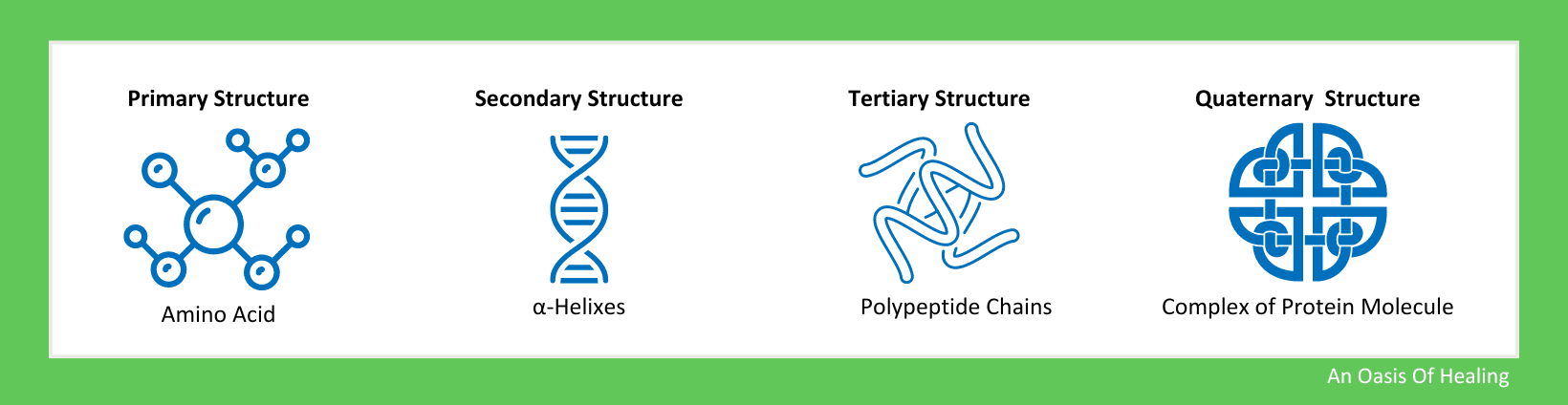
Proteins can be organized in several levels of increasing complexity of their structure1.
Proteins are considered the body’s building blocks2, being also responsible for much of the work developed in cells. Proteins are “required for the structure, function, and regulation of the body’s tissues and organs3.” Furthermore, protein makes up our muscles, bones, cartilage, skin, blood, enzymes, hormones, and vitamins.
Proteins play key roles in growth and development and in the buildup and repair of cells and tissues. They also support many bodily processes and systems essential for life.
One of the ways to categorize proteins is by the function they develop in the body. Below we present different categories of proteins by function3.
Protein is made up of “building blocks” called amino acids. Each protein is made up of hundreds to thousands of these amino acids. The human body needs 20 of these amino acids and can produce about half on its own – eleven non-essential amino acids. The remaining amino acids – the nine essential amino acids – must be obtained from foods that you ingest.
These 20 amino acids can be divided into three categories7:
We have been discussing the role of protein in the human body, but we haven’t addressed protein as a macronutrient. Macronutrients are nutrients that we, humans, need in large quantities, both to provide energy and propel the body’s metabolism, but also to perform many bodily functions. There are three types of macronutrients: proteins, fats, and carbohydrates.
Protein is one of these essential macronutrients. It forms the building blocks of every cell in the body. And the cycle continues, because when we consume it as dietary protein, the body digests it, or breaks it down into amino acids.
The origin of the word protein might give some insight into its importance. Protein comes from the Greek prōteios “the first quality,” from prōtos “first8.”
As we mentioned before, protein is present in every cell of our body and is made of combinations of hundreds to thousands of the 20 different amino acids. The human body can produce about half of the 20 amino acids, but the remaining must be obtained from foods that we ingest.
Hence, our body needs dietary proteins, i.e., protein from food, to build and maintain cells, tissues, and organs, such as our muscles, bones, and skin. Our body then breaks down this protein that we ingest into the simpler amino acids. An interesting cycle of build-up and breakdown.
The amino acids broken down from the diet are now the new building blocks of proteins, and proteins are the building blocks of all tissues in the body. Enough quality dietary protein allows us to build, repair, and maintain our body functioning optimally.
It is with dietary protein that we get most questions, so a quick Q&A may help dispel most of the doubt and concern regarding dietary protein in a plant-rich living foods diet.
The answer is: yes.
Without using any animal products, you are able to obtain enough protein from plants, mainly nuts and seeds, beans, and certain grains.
It depends. How balanced and complete is your diet? How much are you eating and what is the quality of your food?
This is a very individual question. It highly depends on eating habits, food combinations, and the quantity and quality of the food ingested. When transitioning to a living foods lifestyle, and removing animal foods from the diet, more attention is needed to guarantee enough protein intake. It is important to get enough dietary protein because our body does not store protein the same way it stores fats and carbohydrates9. Our protein storage is our muscles, and YOU DO NOT want to break down muscle as a source of protein for the body’s daily needs.
Protein needs vary with several factors, such as age, sex, health status, and level of physical activity. Protein intake also needs to be adapted when facing catabolic conditions, such as cancer, and that is why a personalized approach to nutrition, and the guidance of an experienced professional, is so important.
The Recommended Dietary Allowance (RDA) for protein for an adult is 0.8 grams of protein per kilogram of body weight or 0.36 grams per pound10. This translates to about 46 grams for the average sedentary woman and 56 grams for the average sedentary man.
However, the RDA represents the value required to meet basic nutritional needs (to avoid deficiency or illness), which might not be ideal for every individual. As a Harvard Doctor puts it “In a sense, it’s the minimum amount you need to keep from getting sick — not the specific amount you are supposed to eat every day11.”
As explained in the article “Optimizing Adult Protein Intake During Catabolic Health Conditions12” regarding Dietary Reference Intakes (DRIs):
“The DRIs define a range of acceptable dietary intakes for each nutrient. The range is defined from the minimum intake to avoid the risk of inadequacy (i.e., the RDA) up to an upper limit (UL) based on a detectable risk of adverse effects12.” In the case of most nutrients, like vitamins and minerals, “the minimum RDA is based on alleviating a clear deficiency condition, whereas higher intakes are often recommended to optimize specific health outcomes12.”
The researchers in this study point out that “evidence is accumulating that similar logic should be applied to dietary recommendations for protein12.” They state that “although the RDA for protein of 0.8 g/kg body weight is adequate to avoid obvious inadequacies, multiple studies provide evidence that many adults may benefit from protein quantity, quality, and distribution beyond guidelines currently defined by the RD12.”
Besides dietary protein quantity – the amount of protein consumed – it is also paramount to account for quality, particularly the amino acid profile of the foods we are eating. The constituent amino acids of foods, and especially the nine essential amino acids that we need to obtain from the diet. When looking to optimize metabolism and skeletal muscle protein synthesis, special attention needs to be paid to certain amino acids, like leucine, and this is also relevant for catabolic conditions and situations, such as inactivity and bed rest, so common in cancer patients12.
In conclusion, based on age, activity level, and health condition, much variation can be introduced into the very generalized equation of RDAs for protein and specific amino acids, which highlights the need for individualized approaches to nutrition, and the reason why we do not make a broad recommendation for everyone reading this blog.
It is also important to highlight the fact that catabolic conditions, such as cancer, often lead to accelerated weight loss, sarcopenia, and even cachexia, conditions where low weight and muscle mass may require the adjustment of equations solely based on simple metrics, such as the RDA for protein.
Stay tuned for our next blog in this series: How to Get Enough Protein from Plants
References



Understand all of your options.
Talk with us today about integrative cancer care at An Oasis of Healing.
Become Our PatientOur 4 Week ProgramAlternative Cancer Treatment| Cookie | Duration | Description |
|---|---|---|
| cookielawinfo-checkbox-analytics | 11 months | This cookie is set by GDPR Cookie Consent plugin. The cookie is used to store the user consent for the cookies in the category "Analytics". |
| cookielawinfo-checkbox-functional | 11 months | The cookie is set by GDPR cookie consent to record the user consent for the cookies in the category "Functional". |
| cookielawinfo-checkbox-necessary | 11 months | This cookie is set by GDPR Cookie Consent plugin. The cookies is used to store the user consent for the cookies in the category "Necessary". |
| cookielawinfo-checkbox-others | 11 months | This cookie is set by GDPR Cookie Consent plugin. The cookie is used to store the user consent for the cookies in the category "Other. |
| cookielawinfo-checkbox-performance | 11 months | This cookie is set by GDPR Cookie Consent plugin. The cookie is used to store the user consent for the cookies in the category "Performance". |
| viewed_cookie_policy | 11 months | The cookie is set by the GDPR Cookie Consent plugin and is used to store whether or not user has consented to the use of cookies. It does not store any personal data. |

210 N Center St #102
Mesa, AZ 85201
USA
M, T, Th: 9 AM – 5 PM
Weds: 10 AM – 5 PM
FRI: 9 AM – 4 PM